
My interest was a young 18-year old with the whitest skin I've ever seen. While swimming at the pool it seemed I'd pass a little reflective mirror, dangling easily in the middle of the
 water. It would reflect white strokes of light, and I was quite captured by the illumination.
It got me to thinking- what is the actual color of skin? We see a litany of different hues, but the raisin and pecan rainbow is frequently a result of melanin, a natural pigmentation. When exposed to different varieties of skin color, we're experiencing a visual dose of melanin, not skin.
The color of skin would be naturally translucent, tarnished by the contents of a cumulative of cells and capillaries. Maybe the varied flesh colors we see are a result of mitochondria and nucleii and dRNA, the contents of cells. Potentially, the white lustering skin on the woman I saw today is more indicative of skin's true color.
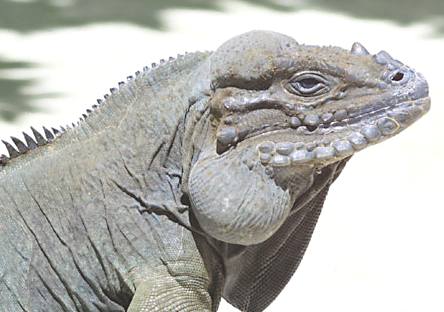
What then, is responsible for the skin color of a reptile? In the course of the dictionary, we run across anoles, box turtles, crocodiles, geckos, and iguanas. What appears to be the "predominant" coloring of our cold-blooded neighbors? GREEN. Light green, black-green, wet green, and blood-green. Ever wondered why they're green?
The logical explanation for their chroma would be the bundles of blood vessels located near the skin. The closer the vessels to the skin, the easier the transfer of heat out of the body on hot days, and into the body on cold days. But oxygenated blood is nearer purple and blue then green. I'll have to consult the color wheel to see what I think about this.
Wouldn't it be neat to disect the cells of cold-blooded creatures and examine the contents- how would they differ from warm blooded creatures? Would they contain certain higher quantites of iron, which can react chemically to form a green substance? Would there be the same type of chemical powerhouses found in green tree-leaves? Is there a daguerrotype of melanin that makes skin green instead of brown?

No comments:
Post a Comment